

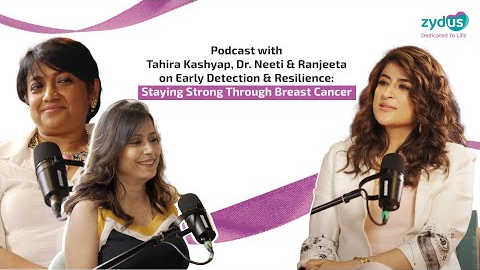


Podcast Transcript: Hope and Healing - Fighting Fear with Hope
Topic: Introduction
Duration: 00:00:00 - 00:01:11
Host: When we hear the word cancer, it often evokes an immediate feeling of fear. Our minds rush to the challenges ahead, the struggles and the uncertainty, leaving little space for something extremely important in this situation: hope. Yet in the face of cancer, hope is the light that guides us. It is what carries us through the darkest moments and leads us towards healing. Today we are here to share stories of hope, stories that inspire, uplift and remind us all of the strength of the human spirit. These stories deserve to be heard, for they hold the power to change perspectives and instil hope in others. We are joined by two incredible women, Ms. Ranjeeta Vinil and Dr. Neeti Leekha Chhabra, both breast cancer survivors and thrivers. They will share their personal journeys of resilience, hope and healing. Welcome to our podcast, Hope and Healing.
Topic: Ambition Before and After Cancer
Duration: 00:01:11 - 00:04:58
Host: After this long introduction, I really want to ask both of you: forget surviving anything else, how did you manage so much hard work and so many qualifications? What gave you the motivation?
Dr. Neeti Leekha Chhabra: About the qualification, I was enrolled for a PhD before I was diagnosed with cancer. After going through the treatment and starting the NGO, all my efforts were somewhere else. But a few years later, when it was the last year to submit my thesis, the only thought in my mind was that I never wanted to look back and think that I could not do something because of cancer. That is what made me complete my PhD and submit it in time. As for the work, one of the major things cancer has taught me is a bigger purpose in life, in the form of the NGO I run, Yes to Life. It has given me a beautiful purpose and direction, and I have been working towards it since 2014.
Host: I am going to talk more about your NGO and the purpose you found. But first, Ranjeeta, what gave you so much impetus to achieve so much, so early? And I am talking about before you were diagnosed. Is it the same spirit that carries on?
Ms. Ranjeeta Vinil: Absolutely. We are talking about a different era. I finished my B.Pharm in 1995, and then I did my MBA, when I was already married. But the instinct of being rebellious, wanting to achieve, being positive and making it happen, that drive was all there. I used to be one of about 50 people in middle and top management. By 30, I think I was a vice president, with a company car, and I enjoyed being one of the few women in a group of 30 men in all my meetings.
Host: You controlled the AC temperature, because men always keep it too cold?
Ms. Ranjeeta Vinil: They might argue, but they all changed it because I was there.
Host: I like that. Boss lady.
Ms. Ranjeeta Vinil: Think of the time I am talking about, 1996 to 1998. And let me tell you, much before all this happened, I was handling India's most expensive breast cancer therapy portfolio for a multinational company. In 1997 and 1998, it used to cost six and a half lakh rupees. Because of my job, there were times I had to meet patients and see what they were going through and how they were suffering, and I did not feel good about it. This was long before I was diagnosed with cancer in 2006. Sometimes things happen for a reason. It was the most expensive portfolio in our industry and I was managing it, but I could not deal with people suffering. The first thing I did when my boss changed was request a change of portfolio. And as luck would have it, life is mysterious and full of surprises, and in 2006 I myself was diagnosed with breast cancer.
Topic: How Neeti Found Out
Duration: 00:04:58 - 00:09:51
Host: Imagine that. Let's come to the journey. Neeti, how and when did you actually know that this is what you had? Was it self-examination, or a regular check-up? How were you diagnosed?
Dr. Neeti Leekha Chhabra: I was diagnosed in 2012, when I was 31 years old. I had never done a self-breast exam. I had no awareness about cancer, leave aside breast cancer. Nobody in my family ever talked about it, and I have been an extremely carefree person all my life. Even as a child, if something happened to somebody in the family, I would not pay attention, because I always thought everything would be fine. And cancer always seemed like a very filmy disease to me, something you see in movies, where if somebody has to die, the doctor always says cancer.
Host: I agree. You actually feel the worst can never happen to you.
Dr. Neeti Leekha Chhabra: But I was very blessed, because the lump was on the surface of my breast. It was a chance encounter. While changing clothes or applying soap, I felt it, and I thought it was related to my periods, since you do feel changes during periods. I slept over it for two months. It is not that I was delaying it. I forgot about it, because I was so sure it was related to my periods. Two months later, I came across it again, and that was when I knew something was very wrong, because something cannot stay in the same place for two months. I was very naive. I actually Googled what to do if you have a lump in the breast. I did not know what kind of doctor to go to. I did not know that breast specialists existed.
So I found a doctor and got an ultrasound done, and the report said the lump was benign, non-cancerous. You can imagine how ecstatic my husband and I were. I remember we went back to the car and I shouted, \"Yay, I don't have cancer!\" and we enjoyed the whole day. But I continued to be blessed. The doctor said that while the report said it was benign, I should get an FNAC done, since it was a lump in the breast.
Host: For our viewers, FNAC is basically an examination where they take a small sample with a needle, which is not very intrusive.
Dr. Neeti Leekha Chhabra: Yes. And since the lump was on the surface, the doctor doing my FNAC said, \"Oh, this is not cancerous, I see so many patients.\" We said, \"Yes, we know already, just do it,\" as if it was just something that had to be done. When the FNAC report came, that is when we learned I had cancer. I was teaching MBA students at that time, and I got a call at my workplace from the centre saying the report was ready and to come with a loved one. So I knew what the report would say.
Host: \"Come with a loved one\" is such a bummer.
Dr. Neeti Leekha Chhabra: I called my husband, and he said he would pick me up and we would go to the centre. I somehow feel it is more difficult for a loved one to digest the news that someone has cancer. In my case at least, I felt that a diagnosis of your own is easier to take than one about a loved one. When we reached, I knew what the news would be, and I was mentally prepared. My husband was extremely distraught. He sat on the chair, and the doctor told me, \"Please look after him. He looks so tense and worried.\" It was the other way round. From there, we went to my parents' house to discuss it, and that is how it all started. I was a mother by then. My son was two years old. On the way, the only thought in my mind was how I was going to tell my parents that their child has cancer. Even though I was 31, to parents, children are always children, whatever their age.
Host: Of course. But 31 is young. Very honestly, I was also in a naive space. When you think of any disease, you think it happens at 50 or 60 plus. Who has heard of anything at 31? I was 35 when this happened, and I thought I was the youngest, but when I spoke to the doctor, I was shocked by the statistics. More about that later.
Topic: How Ranjeeta Found Out
Duration: 00:09:51 - 00:15:00
Host: Ranjeeta, how was the journey for you? What phase of life were you in, and what led to the discovery?
Ms. Ranjeeta Vinil: As I told you, I was aware, because I had worked with oncologists. But it was because of my love for massages that my masseuse, in 2006, noticed something unusual. It was like a little marble. I was working on a project with deadlines, and even though I knew there could be a chance, I thought, let me give this two months to finish the project, because there was a lot of travelling. My son was four then, and I was also 31 or 32. I could have done better there. In two months, it grew, and it just did not feel right, because we know a benign lump would not grow so fast. I finished the project, went for a mammogram when I came back to Bombay, and the radiologist told me something was not looking right.
At this point, I was doing everything all by myself, because my husband was a naval officer posted elsewhere. And, a little melodramatically, it was also the day before my last day at the organisation where I had worked for 10 years. That same day I went to Breach Candy, to the breast cancer surgeon everyone knew, who is no more, and he did an FNAC. The next day I was to get my report, and that was also the last day of my long, lovely corporate journey. There was a lot of nostalgia and a lot of memories. It was a very heavy, emotional day: leaving my cabin, handing over my laptop. Then I went to Breach Candy again, alone, and the doctor told me, \"This is cancer.\"
I did not call anybody. Nobody knew I was at Breach Candy. I was alone, but the doctor knew me. He said, \"It's fine, I will make room for you.\" I said I wanted to be admitted right away. I did not have the money. I had nothing. It was my last day in the corporate world, so there was no insurance cover, and I did not know what I would do, because my husband was not in Bombay. But I decided to get admitted. I was admitted by about 6:30 or 7 in the evening, and I had my surgery the next day at 8:30.
Host: They gave you a surgery slot within 24 hours?
Ms. Ranjeeta Vinil: I wanted it done, because I had delayed for two months. Now that I knew, I wanted it done as quickly as possible. We know how people delay these decisions and how it affects them. And because the doctor was there, someone I knew through my professional work, there was help. That is when I informed my parents. My husband, who could not believe it, came the next morning. My four-year-old son was at home. My company, because I had had a long and lovely innings, said they would reinstate me. My husband was at the hospital, some friends were around, and I was wheeled in. The only thing I was worried about was where I would be after the surgery, and whether they would give me a poolside room, because the previous night they had put me in a junkyard of a room that I did not deserve.
Host: I love the battles we choose. A pool-view room!
Topic: Did Knowing More Make It Harder?
Duration: 00:15:00 - 00:20:04
Host: Let me interject a little. Neeti was the naive one, as was I. But you were associated with the field. You knew the how and why of it, the repercussions, the treatment and the expenses. And here you were, diagnosed with the same thing. Did that knowledge throw you off? Were you scared because of what you already knew? Was it detrimental to your healing journey?
Ms. Ranjeeta Vinil: No, I do not think it was detrimental at all. I think, beyond knowledge, it is about individuality, personality and how you look at life. As I said, when I was being wheeled in, my whole worry was the room. For me, it was just a surgery. In those days, any cancer was a death sentence, but I did not look at it that way. I just thought it was another surgery, it would be over, and then I would look forward to a room with a swimming pool view. Everybody around me was crying, my parents and friends, and anybody who was there still quotes this: I was only thinking about getting the surgery done and getting out, because my four-year-old son was waiting. That was the only thing I was a little worried about, not being around him. I have always been a professional who travelled, but this was different.
For any mother or any woman with cancer, however bold we act, there is fear, even today, although we have a lot of the latest treatment options available. Also, when you are young, doctors take a little more precaution. For me, it was stage 1, but grade 3. My lymph nodes were not involved, but the doctors took action and removed all the lymph nodes on my right side. I was told not to use that arm, but trust me, my love for strength training started from there, and I can do anything.
Host: That's amazing. One thing I have found common between the two of you: one is from Delhi and one is from Mumbai, both very well educated, surrounded by educated people, experiencing life in the best possible ways with love and privilege. Yet both of you sat on it. When I shared my own journey, I did the same, because what could possibly happen to a 32- or 34-year-old woman? I sat on it for about 10 to 15 days, maybe a month, because the symptoms kept changing. So many people are not even exposed to the privilege we have had, and yet we sat on it. That is what I keep trying to share. I asked both of you at the start whether you were okay with anything I might ask, and both of you said everything is open. I understood that sentiment came from wanting to spread awareness and knowledge as much as possible. Early detection always helps. Never, ever sit on any symptom. You felt going back to office work was more important than an appointment, even though your masseuse told you. With God's grace, there was protection. But none of us should sit on a symptom for even a second, even if people call it stupid. That is what I tell people: if there is something you do not understand, just go and get it examined. What is the worst they will say? That you are being silly. That is fine.
Topic: Breast Cancer Can Happen to Anyone
Duration: 00:20:04 - 00:23:24
Dr. Neeti Leekha Chhabra: That is so true, because even today, a lot of educated women feel that not doing a mammogram is a good solution, because of family and other reasons. That is a myth.
Ms. Ranjeeta Vinil: I am a live example. It can be as simple as stress, if we call it simple. I was an ambitious girl who wanted to achieve in a man's world, and there is nothing wrong in that.
Host: Very honestly, there is a lot of guilt that goes with this. I am also a very ambitious woman, and at times people try to put you in a box because you are ambitious. Everybody is ambitious. Perhaps we just did not deal with our stress levels as we should have.
Ms. Ranjeeta Vinil: That is the only difference. We may all have cells that respond or react differently in different situations. So for all the women out there: self-examination, and if the mandate is 40 years, go and get your mammogram done, with no reservation or inhibition.
Host: Absolutely. And to support what you just said, a statistic says that only one in 10 women who get breast cancer get it from their family. For the rest, it is not hereditary. In my case, it is not in the family either. And you, if I may ask?
Dr. Neeti Leekha Chhabra: I had no high-risk factor. No family history. I got married at the right age, had my son at the right age and breastfed him. Whatever they say should be taken care of was automatically taken care of, but it still happened. If it were so black and white... The youngest girl we know who has been diagnosed with breast cancer is 16 years old.
Host: My doctor told me about someone who was 17.
Dr. Neeti Leekha Chhabra: So whatever we say about getting married at the right time, while those points are important, it is important to understand that breast cancer can happen to anyone. Women with certain high-risk factors have a higher chance, so doctors may advise a different frequency of screening for them. But women without any high-risk factor can also get it.
Host: Absolutely. It is not that every woman who is not married or has not had children will get breast cancer, and that awareness should also be shared with women. I think a lot of it also has to do with lifestyle.
Topic: Neeti's Treatment and Reconstruction
Duration: 00:23:24 - 00:29:31
Host: But I will come to that after I ask you this: how was your treatment, and what was your post-treatment condition? Were you recommended chemotherapy, radiation or surgery? I am using these words because they are part of the treatment, and rest assured, the idea is not to scare anyone. Early breast cancer is not just treatable, it is curable. The idea of this lovely Hope and Healing podcast is to give hope: even if you do end up with cancer, if it is detected early, you are in a good space.
Dr. Neeti Leekha Chhabra: Mine was an early-stage breast cancer. I was diagnosed at stage 1. I remember my doctor telling me it was an early-stage cancer, and I sat across from her wondering how any cancer could be early. Then, when I read more, I understood. While the lump was small, I also had DCIS, which was bigger in size. I was initially told I would have breast-conserving surgery, but just a day before the surgery, there were more investigations. They took me into a room for a final ultrasound, and that was when they told me I had to undergo a mastectomy, meaning one breast had to be removed. Those 10 minutes were very tough, going from thinking that only a very small portion would be removed to being told the whole breast had to go. I am not saying it is easier for older women, but it can be more difficult at a very young age.
Host: Of course it is. You were all of 31.
Dr. Neeti Leekha Chhabra: I remember shivering while being taken for that ultrasound. But as soon as the doctor told me what was going to happen, I accepted it, because the only thought in my mind was that if I could continue to live by losing a body part, so be it. I have been so thankful to God that it was in a part that could be removed. Some cancers are in vital organs that cannot simply be removed.
Host: With both of you, I am so glad you did not play the victim card, as most of us do when something falls on us. You are sharing this so that other women do not have to suffer. Whatever the problem, if there is a solution, it is protection of the highest order. That is life-saving.
Dr. Neeti Leekha Chhabra: And solutions start once you accept it. With cancer, the word death is always associated with it, so acceptance often comes very late. As I said, I accepted that it had to be removed. I had a partial reconstruction done at that time. The doctor asked about reconstruction, but there was no time. It was the night before surgery, and I told them to do whatever they felt was right for now, and I would think about it later, because I had no knowledge, and how much could I find on the internet the night before? So they did an LD flap, where muscle from the back is moved to the front. After that, I had proper chemotherapy. The doctor said, \"You are so young that we do not want to take any chances and leave anything behind. In an older patient, we might have skipped chemotherapy, but for you, we want to do it.\" So I had four cycles of AC or EC initially, and then I was given a choice of four cycles of Taxol or 12. I chose 12, and then hormonal treatment for six years.
Ms. Ranjeeta Vinil: Mine was moderately positive, and I took tamoxifen for six years. Every case is very different, and so are the side effects.
Host: The idea is not to throw anyone off with these terms, but to make you aware. Education is always good.
Topic: Losing a Breast, Keeping Your Shape
Duration: 00:29:31 - 00:32:17
Dr. Neeti Leekha Chhabra: When I was undergoing the mastectomy, the doctor told me that with the LD flap surgery, I would have a normal breast when I woke up. That was the idea I had, that they had done a full reconstruction and I would have a breast like the other side. But when the bandages came off, I realised that a very small pocket had been formed. It was not the same size, and it was not a proper reconstruction. Three years later, I decided to get reconstruction done. So it is very important to tell the women listening that losing a breast to cancer does not mean you cannot have your physical shape back. You can keep an artificial breast in your bra, which I did for three years, and it gave exactly the same shape. Except for me and my partner, nobody could tell that I did not have a breast. Three years later, I got reconstruction done, so that is also an option. But the point is that nothing should deter you from going to the doctor at the right time. This fear of losing a breast is one of the major reasons women do not go to doctors, while in most early-stage cancers, only a small part has to be removed and your body image remains intact.
Host: That's true. There is so much more than one part of the body. You had a two-year-old son, who is now in class 10. Your child was four at that point. There is so much more to look forward to, and so much depends on you, that this is barely a price to pay. In fact, it is a boon from the heavens, and from the doctors, that there is a solution, and after your operation you can go back to living life with your family.
Topic: Ranjeeta: Working Through Treatment
Duration: 00:32:17 - 00:38:27
Host: I want to ask, only if you want to share, how normal was it to bounce back to your normal life after treatment?
Ms. Ranjeeta Vinil: For me, after the surgery came chemo. Because of my age and the grade 3, it was fairly progressive, so the doctors wanted to give me every treatment possible, which meant chemo and radiation too. I was triple positive, ER, PR and HER2 positive. That simply means every woman out there will be different, and that is why we talk about early diagnosis. Nothing to get worried about, but the treatment is long-drawn if you have all three.
Once I started chemo, the first time, my oncologist told me, \"You are stronger than cancer.\" I really took that personally, to beat it. Meanwhile, interestingly, I also changed my job, because I did not think it was morally right to go back after I had left. The MD of my new organisation came and told me I was most welcome to join, irrespective of my breast cancer, which was then like a death sentence. I must appreciate them. So I joined the new company, a smaller one, with bigger responsibility. I was managing my chemotherapy, and as I told you, my husband was away. I am sharing all this for the women who will hear it: it is all possible. I used to go for my chemotherapy almost alone, dressed as if I was going to the office. I used to meet patients, because on chemo days at that centre, there were so many people suffering. Somebody had relapsed a third time, and people felt it was the end of life. My medical oncologist was very happy to take me around the hospital so people could see someone like me.
My husband was in the Navy, and something was happening that meant he could not come back to Bombay, so I had to do this by myself. To help, my husband took our son with him, so that he got attention, and I had a basic help at home. So I used to go for chemo, and this was my hospital drill: meeting everybody, then the chemo drill, which is a long, whole-day process. On the first day of the first cycle, my husband was there, and the hospital, without naming it, forgot to give me the anti-emetic for nausea. Chemo has all those side effects. Nowadays there are a lot of targeted therapies, but in those days, in simple language, chemotherapy could not tell normal cells from abnormal ones, so it acted on both. I was taken back to the hospital and put on saline, but I still went to work on the third day. I lived in Colaba, drove to Andheri and left office at 8:30. That is what I did between cycles, and I was able to work efficiently. This went on for six cycles.
Then came radiotherapy at Jaslok. I would drive to Andheri, come to Jaslok for my afternoon slot, because they have slots till 3, and go back to the office, because there was so much work. That went on for a month. A friend of mine, Chhavi, once said that in all this making it happen and never giving up, where is the self-care you need to focus on? But for me, work kept me so busy that sometimes I even forgot I was being treated for so-called cancer.
And something that very commonly happens is that we lose our hair. Not all therapies are targeted, so all growing cells are affected, and for women it is a big thing. A lot of things did not affect me emotionally, but I remember I took permission and went to a conference in Dubai after my first cycle. When I got up in the morning, there was a bed of hair. I was taking everything so well and positively, as if it were just another disease, and it just hit me. But because I had anticipated it, I had a natural-hair wig made that looked like my short hair. This was just after the first cycle, so it was not that I had lost all of it, but it was clumps of hair. That is what a lot of women get psyched about, especially Indian women.
Topic: Hair Loss and Emotional Moments
Duration: 00:38:27 - 00:44:29
Ms. Ranjeeta Vinil: I went to the same hairdresser, and she made the same hairstyle out of that wig. Then for the next nine months, I got compliments on my lovely hair and haircut on flights and everywhere.
Host: That's so lovely. All of us have various options. Neeti, you also went through chemotherapy. You must have lost your hair as well.
Dr. Neeti Leekha Chhabra: I was very much prepared that I was going to lose my hair. I had almost waist-length hair when my treatment was to start, and I knew it was going to fall, so I got it cut very short. Later I realised I should probably have shaved it off completely, because when it fell, it came out in chunks in my hands, and those two or three days were emotionally very down, seeing chunks of hair in your hand. But I wore a wig only twice in the six to eight months I had chemo. Mostly I went around just like that, or tied a scarf on my head. I was never very comfortable with the wig. Once was at a family wedding, because there were in-laws and others around who did not know what I was going through. The other time, I remember, was very emotional. I had gone to pick up my son from school, and I did not want everybody at his school to know, because then the focus comes on the child too, that his mother is going through this. So I wore the wig, showed the ID card to the guard, and he said, \"No, no, this is not you.\" I said, \"Look carefully, this is me.\" He said, \"No, you don't look like his mother.\" I felt very emotional, because when people cannot recognise you as your son's mother because of hair loss... But other than that, I have been pretty much okay with it.
Host: The treatments are still fine. It is these emotional moments that a lot of women and families will connect with, and we need to talk about them. I will share one thing too. When I was given chemotherapy, I had just heard a line that human beings are hopelessly hopeful till the end. The doctor said that in one in I do not know how many million cases, the hair does not fall, and I was convinced. That conviction took me to at least the fourth or fifth cycle. The hair was shedding, but after that, everything just started coming off, and that is a little more depressing, when you just run your hand through it. That is when I called my hairdresser and said, \"Shave it all off.\" Of course, you give yourself that confidence, and there are various things people resort to. There is family, and I am sure you both had tremendous family support. There are a lot of philosophies and religion, and all these things give you strength. I had my own source of strength.
But coming to my very close friend's wedding: we had all been looking forward to it for a very long time. Her name is Neeti Mohan, and she is a singer and an amazing human being. I wanted to wear all the beautiful dresses, but somehow I was not comfortable with a wig. I had one made, because you do not know how you are going to look. My friend and I have done all sorts of silly things, so we opened an app to see how I would look bald, with red hair or pink hair. It looked completely different. I never took to the wig. I got a lot of scarves, because my friend was coming from Dubai, where a lot of people wear hijabs, and I thought I would carry it off, but that did not go well either. When I was just without anything, I felt more comfortable. So I attended my very good friend's wedding in all the lehengas and cholis, with sports shoes and a bald look. I think it is about how you feel and how your environment supports you. People looking at you with pity, as a victim, does not help. You do not need extra attention at that time, because you are not feeling it that way.
Topic: Finding Strength
Duration: 00:44:29 - 00:49:03
Host: So I want to understand: what was your source of strength? We will start with you, Neeti.
Dr. Neeti Leekha Chhabra: As I mentioned, when I went to my parents' place to tell them about my diagnosis, we are three sisters. One was in the US, and my younger sister is 13 years younger than me, like our baby. My parents were of course crying and very emotional, and I remember hugging them and telling them I was going to be okay. While I had not seen anybody go through cancer, somehow I had a very strong faith that I was going to be okay.
Host: Where did that faith come from? That wave of optimism? A lot of people going through it right now really want to understand how to generate hope and what to hang on to.
Dr. Neeti Leekha Chhabra: Two or three things. One, I accepted it. Acceptance is very important, because as soon as you accept, healing starts, whether physical or emotional, and you move towards your action points. As soon as you accept, you are on the right road in the right direction. Acceptance came naturally to me. The moment I knew, I accepted that this is what it is. In fact, the reason we went to my parents' place was to talk about what next. My father is a hospital consultant to certain hospitals, so I knew we could get information from him. Right then, my mind started on the next steps.
And during the journey, there was my son. As I said, he was just two years old, so I knew I had to be okay for him. I was very blessed to have a supportive family, so even if something had happened to me, there would have been people to look after him, but a mother's role is something no one else can fill. The only time in my treatment that I ever felt low was when I thought, \"What if something happens?\" which was very rare. I would cry for two or three days after every chemo. It was a natural reaction. I even used to tell my husband that some chemical reaction happens two or three days after every chemo, because I would invariably cry. But the good part was that I never let myself go into the thought process of \"What if this happens, what if that happens,\" because that is very easy to go into and very difficult to come out of.
Host: So one was acceptance, and the second is stopping yourself from having negative thoughts. We have the power to stop that thought process and stop ourselves from spiralling down.
Dr. Neeti Leekha Chhabra: I would cry, and then I would come out of it. It is absolutely okay to feel low at times. It is absolutely okay to feel emotional and to cry. It only helps you vent those feelings. But as you say, it is important to stop. And what I also did: my husband and I have a dream of settling in Goa when we retire. I always used to imagine the beach and the shacks, the life I want to finally lead. I used to visualise my husband, my son, my daughter-in-law and their child, all of us chilling there in the future.
Host: Literally, I got a shock: she has a daughter-in-law? She looks like this! That would be another podcast.
Dr. Neeti Leekha Chhabra: I used to imagine all of us together at a Goa beach, roaming around and having fun, and that really helped me. I told my sister this today, and she said, \"I'm sure you think you will look like this then too.\" I said, \"Of course. Who can imagine how they will look when they are old?\" But it gave me a lot of peace to see myself at a place I love, with my family and loved ones, everybody healthy, hale and hearty.
Host: I am visualising the same for you. You are eternally beautiful. At 60 you will look like this, with just a few strands of white, in this beautiful beach life. Great affirmations. To make it concise, three key points we can take from what Neeti has shared: one, acceptance. You have got something, accept it, and the next step is to deal with it. Two, stop the negative thoughts. You are bound to have them, so feel them, but get over them. And three, positive affirmations. Visualise something you look forward to.
Dr. Neeti Leekha Chhabra: And one more thing. A lot of people say it is easy to say \"be positive\", but it is a very different game when you have to do it. During my treatment, I read a lot about spirituality, I listened to people with very practical insights, and I did things that gave me a lot of happiness. I have experienced that if you take in positive input for even 30 minutes every day, it starts to change the way you think. You have to take certain actions towards better well-being and better mental health, but it does happen.
Topic: Ranjeeta's Mantra
Duration: 00:49:03 - 00:54:26
Host: Thank you so much for sharing that. Ranjeeta, I want your inputs as well. Three key points?
Ms. Ranjeeta Vinil: For me, it was quite simple, because I accepted it. And I think love for life is the key for me. I never thought anything would happen. I just took it like any other disease. The only thing that troubled me a bit was the long-drawn treatment compared with other diseases. I was not worried about anything else, and I never felt low. I was quite busy, and I kept it that way, so there was little time to think about anything beyond family and health. Affirmation, for sure. There was no scope or room for negative thoughts, and I live by that even today. Anybody who knows me will say this, because for me, there is no other way to live life.
Host: So, three key points from you. The first is acceptance, which is common. Number two, you kept yourself busy with something you really like. You had a schedule in place and you did not sit on it. Of course body aches happen, and every case is very different, but if you can pull it off, and your doctors have given you permission to step out into the world and work, do not stop yourself from living and achieving your dreams. And third, positive affirmations, with no scope for negativity.
Ms. Ranjeeta Vinil: Absolutely. A lot of us go into a denial phase and waste a lot of time thinking \"why me\", whether educated, uneducated or powerful. But it is there, and we have to accept it. Easier said than done, but that is the only way: be positive, take it in your stride and get it done. And I celebrated. As I told you, the only thing that worried me was that it was long-drawn. For me, it was years of Zoladex injections every month, because I was HER2 positive and grade 3, and I did not take Herceptin. The option was this, and I chose it.
Host: I was also triple positive, and I took Herceptin.
Ms. Ranjeeta Vinil: I chose the Zoladex path. Every month I would go, and sometimes, if my regular nurse was not there, another nurse would give me the injection and there would be a fountain of blood, and then I would go to work. But I have been good since. I have been much healthier than before. I started exercising and strength training.
Topic: Strength Training and Bone Health
Duration: 00:54:26 - 00:56:41
Host: That actually brings us to this. You both seem so fit, beautiful, glowing and absolutely stunning.
Ms. Ranjeeta Vinil: On exercising: as I said, I took to strength training way back, because the treatment can leave you fragile. I was weightlifting too.
Host: I think that is the more educated way to go about it. Something I learned just two days ago from a senior radiologist, because we women just want to share whatever knowledge we have with everybody: until about 35, whatever gains you make are your bone density gains. So do a lot of weight training. You are not going to become Salman Khan, because you do not have that much testosterone in your body, and I think that notion is gone now. In fact, weight training is extremely important for women. Build as much as you can until about 35. After that, there is a 1 to 2% decline every year, which is not to say it is a downfall. You can still sustain it with a good amount of weight training, which stops you from going into osteopenia, which eventually leads to osteoporosis. It is connected to chemotherapy too, and especially post-40, you start to feel those changes in the body, so muscle strengthening is a must.
Topic: Long-Term Side Effects
Duration: 00:56:41 - 01:00:39
Host: I quickly wanted to ask you, since you have both been through chemotherapy, and it has been 12 years for you, Neeti, and close to 20 years for you, Ranjeeta. Touchwood, God bless, you are in a good zone. Chemotherapy causes many side effects: pain in the legs, nausea and many other things. Do they ever go away? Do you completely get rid of them?
Dr. Neeti Leekha Chhabra: One thing I want to add, not exactly answering your question: anybody who is going through treatment, please do not Google the side effects, because psychologically you start to have them. For me, my general health has really improved since treatment. My stamina used to be very low. I was an athlete throughout my school years, but every time I ran properly in athletics, I would develop a fever that stayed for a day or two. Now that has become much better.
Host: That's amazing. And you?
Ms. Ranjeeta Vinil: I have no side effects now. In the first year or two after treatment, there were a couple of things. Sometimes radiotherapy can leave some charring of the breast, though now there is so much targeted therapy that you may not even have that. Sometimes there may be fatigue because of chemotherapy. But all of this can be managed. That is very important to know. And it has gone completely.
Host: Very honestly, one big thing that stops women from completing chemotherapy, or even opting for it when doctors advise it, is the side effects. Here I have two lovely women who finished treatment years ago. One has become a better athlete, and one is the epitome of positivity. So I think it is a state of mind, and nothing should deter you from completing your treatment. If the road through treatment looks long, survival is a longer road. The time you have to spend with your family, and the goals, missions and dreams in your life, are far more important than this brief period of suffering, which can stop feeling like suffering because of your state of mind. Surround yourself with a lot of love and happiness.
Ms. Ranjeeta Vinil: For all the lovely women, I just want to add one thing, Tahira. When we take any treatment, there will be some side effects, but that does not mean all of them will come to every woman. When we read the literature or get information, we feel all of it will happen to us, and that may not be true. At the same time, if a medicine is working, there could be some side effects. That is another way of looking at it.
Host: It is good, in fact. When I told my doctor about the nausea, he said, \"Good, that means the chemotherapy is working.\" So the idea is for all of us to be positive. And very honestly, we are talking about cancer and chemotherapy, but if we bring this under the big umbrella of \"a problem\", the beautiful key points you have both shared can be extended to every aspect of life: a financial problem, a marital problem, so many problems.
Topic: Mental Well-Being and Purpose
Duration: 01:00:39 - 01:03:56
Host: I am going to ask you two brief questions, and they will not be the same for both of you. Neeti, what was your mental well-being like, and how important is it? And what is the one message of hope you want to share with people watching this podcast?
Dr. Neeti Leekha Chhabra: Mental well-being is extremely important, even if you do not have an issue in your life, so that one does not get created. It works both ways. I believe in the idea of creation: if you are very positive, you are part of the creation process around you. I was never a person who took a lot of stress, even before cancer, but it has become even better now, because it is much easier for me to prioritise. You understand the importance of everything that is happening in your life.
Host: Do you blame anything or anyone? Do you have a reason why cancer happened to you?
Dr. Neeti Leekha Chhabra: When I was undergoing treatment, \"why me\" was never a thought that came to my mind. But my husband and I would often discuss that if something this big has come into our lives, there must be some learning in it. So my perspective was always to find the learning: what can I learn from this, if it has happened? That beautifully came into my life with a bigger purpose, which I now pursue through the NGO I run, Yes to Life. We work on breast cancer awareness and patient support, financial, rehabilitation and emotional, and the satisfaction and gratification I get from it is immense. I am a spiritual person, so if I ask why this happened to me, all I can think is that we choose certain bigger experiences to happen to us in a lifetime, and if this was to happen to me, the free will about what to make of it was mine. I chose to start this work. I left my job and started this. It was not always an easy decision, because all your life you have been a working woman with a designation and an income, and that all changes. But that is also part of mental well-being. When you are very clear about your goal and about what gives you happiness, all my decisions are now taken around what gives me peace of mind. That is how life has become easier. It has become much easier to let go.
Host: I am going to change your name. You are the Buddha. Thank you so much for sharing such a beautiful insight. I also feel spirituality really helps you heal. You are both practical people, of course, and I am very practical too, but I also believe in the goodness of something beyond us. I do not know how to put it in words.
Topic: A Message of Hope
Duration: 01:03:56 - End
Host: Ranjeeta, the last bit. What do you want to share with people about how they can find hope?
Ms. Ranjeeta Vinil: I think we are all examples of hope. We all fought our battles. We always wonder what purpose comes out of these things. But when I look back, imagine: I was handling a cancer portfolio in 1997, working with patients, and I wanted to get away from it. And then I got cancer. What are the odds? To add to that, in my last role before I had cancer, I had about 100 people in my team working across different disease areas, helping patients cope. And then I had cancer. How could I not pick up the signal? With that, I think, as an individual, I became more compassionate, more passionate and more driven to create something that did not exist in India. The patient-support company I went on to build has worked with more than 50 lakh patients across India, and I think we have made an impact on people's lives, with a focus on early diagnosis, disease outcomes and hand-holding.
We talked about the spirit: how we look at affirmations, how we look at everything positively, and how important family support and spirituality are. My belief is the same as yours. Long ago, I did three or four Vipassanas, when all my friends used to run away from them. It comes easily to me. I used to attend Sadhguru's discourses when people had not even started going, whatever it cost. Of course, there is a belief that there is so much goodness out there, and nothing in life happens without that energy and power we probably cannot see. All these signals were picked up from the universe, to do the best I could in my individual capacity. I did not have a lot of money, so I could not start a foundation. But I thought, there is an industry out there, and there are patients who pay for treatment. We do not charge any patient anything. There is a large industry that supports us to provide this care, and that is what we have achieved.
Host: So beautiful. You have turned something that was given to you into something more meaningful, and if spirituality ever has a meaning, it is humanity. Both of you are exemplary: one of you runs an NGO, and the other runs a service-based company that hand-holds patients and helps them through, financially and in other ways. What was given to you, and what you made of it, is free will. It is up to you whether you play the victim card or say, \"If it has happened to me, it has happened for a reason, and I am going to turn it around and make some greater good out of it.\" You are both living examples of that. Thank you so much for joining us for such a lovely podcast. Here's to hope and healing for everyone.
Ms. Ranjeeta Vinil: Thank you. Lovely chatting with you, and thank you, Zydus, for organising this.